The data silo problem that limits every autonomous system
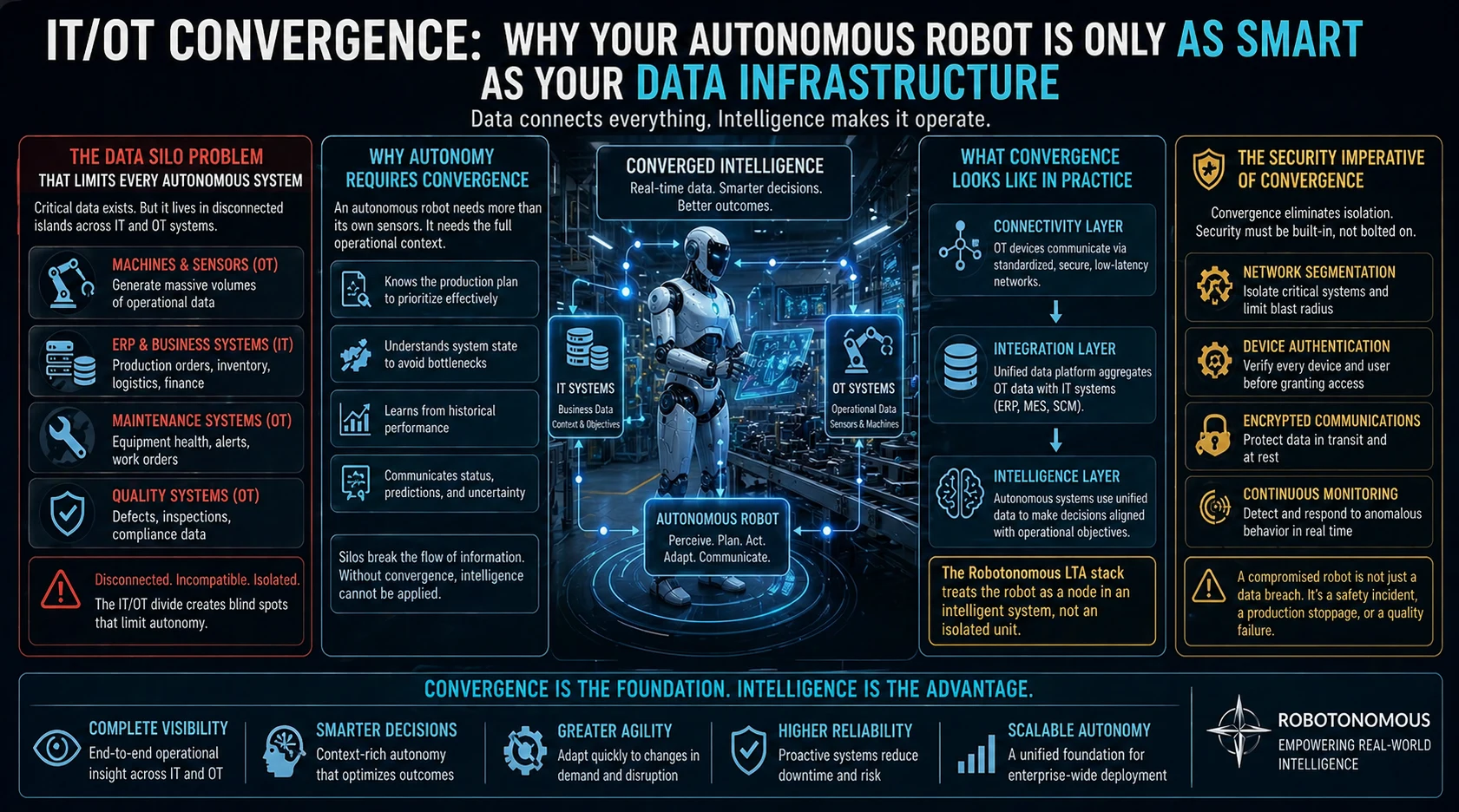
Ask any operations leader about their factory’s data situation and you will hear a familiar story. The machines generate enormous volumes of sensor data. The ERP system tracks production orders, inventory, and logistics. The maintenance platform logs equipment health. The quality system records defect rates. Each of these systems is, in isolation, sophisticated and valuable. Together, they are a collection of disconnected islands — data sitting in formats that were never designed to communicate, managed by teams that have historically operated independently.
This is the IT/OT divide. Information Technology systems — the software that runs business processes, processes data, and supports decision-making — have evolved separately from Operational Technology systems — the hardware and software that controls physical processes on the factory floor. For decades, this separation was acceptable, even sensible. OT systems were isolated from networks for security reasons. IT systems did not need real-time physical data to perform their functions. The two worlds operated in parallel without significant friction.
Autonomous robotics changes this equation entirely.
Why autonomy requires convergence
An autonomous robot making real-time decisions needs more than its own sensor data. It needs to know the current production plan to understand which tasks are highest priority. It needs to know the state of adjacent systems — conveyor speeds, buffer levels, upstream process status — to plan its actions without creating bottlenecks. It needs access to historical performance data to calibrate its behaviour against what has worked in the past. And it needs to communicate its own status, its predictions, and its uncertainty to the systems that depend on it.
None of this is possible when IT and OT systems operate in separate silos. An autonomous robot connected only to its local control system is like a highly skilled worker who has never been told what the factory is actually trying to produce. The capability exists. The intelligence cannot be applied because the information flow is broken.
What convergence actually looks like in practice
Effective IT/OT convergence is not a product you buy — it is an architectural outcome you design toward. At the connectivity layer, OT devices — robots, sensors, PLCs, vision systems — need to communicate their data in standardised formats over secure, low-latency networks. At the integration layer, a unified data platform aggregates operational data from physical systems with business data from ERP, MES, and supply chain systems. At the intelligence layer, autonomous systems consume this unified data to make decisions that are not just locally optimal but aligned with broader operational objectives.
The Robotonomous sensor fusion and autonomy module is engineered for this converged architecture. Rather than treating the robot as an isolated unit, the LTA stack treats it as a node in a broader intelligent system — receiving context from connected enterprise systems and contributing its own perception data to the shared operational picture. The result is autonomy that is not just technically capable but operationally intelligent.
The security imperative of convergence
The IT/OT divide, whatever its operational costs, did provide one accidental benefit: isolation. OT systems that were air-gapped from networks were largely inaccessible to external attack. Convergence eliminates this isolation — and introduces the security challenges that IT systems have been managing for decades to environments where the stakes are physical, not just digital. A compromised robot controller is not just a data breach. It is a safety incident, a production stoppage, or a product quality failure.
Security architecture must be a first-class consideration in any IT/OT convergence programme — not a retrofit. This means network segmentation, device authentication, encrypted communications, and continuous monitoring of anomalous behaviour across the converged system. Organisations that treat convergence as a pure integration problem and defer security will face consequences that no amount of retrospective patching can fully address.