The scale of the problem that automation must solve
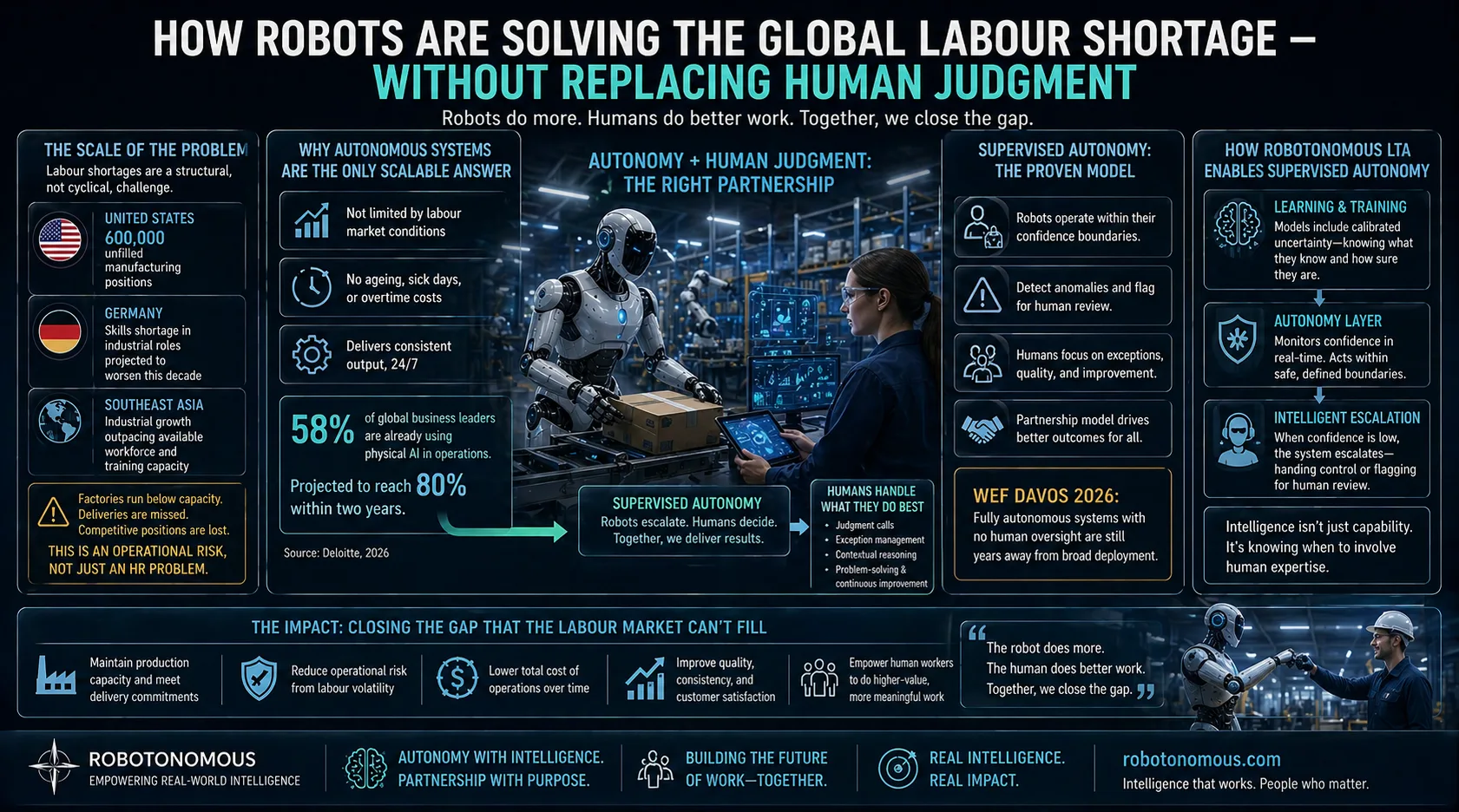
The numbers are striking. The International Federation of Robotics reports that employers across every major industrial economy are struggling to fill specialised manufacturing, logistics, and operations roles. In the United States, there are an estimated 600,000 unfilled manufacturing positions. In Germany, the skills shortage in industrial roles is projected to worsen through the decade. In Southeast Asia, rapid industrial growth is outpacing the available workforce faster than training programmes can respond. These are not cyclical fluctuations. They are structural shifts driven by ageing populations, changing educational preferences, and the increasing technical complexity of modern manufacturing roles.
The consequence is not abstract. Factories operating below capacity because they cannot staff production lines represent real economic output foregone, real delivery commitments missed, and real competitive positions lost. For organisations that depend on consistent, high-volume production, the labour gap is not a human resources problem — it is an existential operational risk.
Why autonomous systems are the only scalable answer
Conventional responses to labour shortages — higher wages, expanded training programmes, immigration policy — operate on timescales of years and address symptoms rather than structural causes. Autonomous robotics operates on a different logic. A robot does not age out of the workforce. It does not call in sick. It does not require overtime rates for weekend shifts. Once deployed and validated, it delivers consistent output regardless of labour market conditions.
This is why, according to a Deloitte survey of more than 3,200 global business leaders, 58 percent are already using physical AI in their operations — and that number is projected to reach 80 percent within two years. The adoption is not driven by a desire to replace workers. It is driven by the recognition that the alternative — leaving production capacity unfilled because qualified human operators are unavailable — is unsustainable.
The supervised autonomy model — why full replacement is the wrong frame
The framing of robots ‘replacing’ workers misunderstands how effective autonomous systems actually operate in production environments. Leaders at WEF Davos 2026 were clear on this point: fully autonomous systems that require no human oversight are still years away from broad deployment. The near-term reality — and the commercially proven model — is supervised autonomy. Robots handle the repetitive, physically demanding, and high-volume tasks that have the clearest automation pathway. Humans handle the judgment calls, the exception management, and the contextual reasoning that current AI systems cannot reliably replicate.
This division of labour is not a temporary compromise. It is a genuine partnership that plays to the strengths of each party. A robot that can detect an anomaly and flag it for human review, rather than either ignoring it or shutting down, is more valuable than one that operates in complete isolation. A human operator who is freed from eight hours of repetitive material handling can apply their judgment to quality, problem-solving, and process improvement — work that actually benefits from human intelligence.
How the Robotonomous LTA framework enables supervised autonomy
The supervised autonomy model requires more than capable hardware — it requires an intelligence layer that knows the boundary of its own competence. The Robotonomous LTA system is designed to operate at this boundary intelligently. The Learning and Training layers build models that include calibrated uncertainty estimates — the system knows not just what it believes, but how confident it is in that belief. When confidence falls below the threshold required for independent operation, the Autonomy layer escalates appropriately, handing control or flagging for human review rather than proceeding with insufficient certainty.
This is what makes autonomous systems trustworthy in labour-constrained environments: not the elimination of human involvement, but the intelligent management of when that involvement is needed. The robot does more. The human does better work. Together, they close the gap that the labour market alone cannot fill.