
Why humanoids are suddenly everywhere
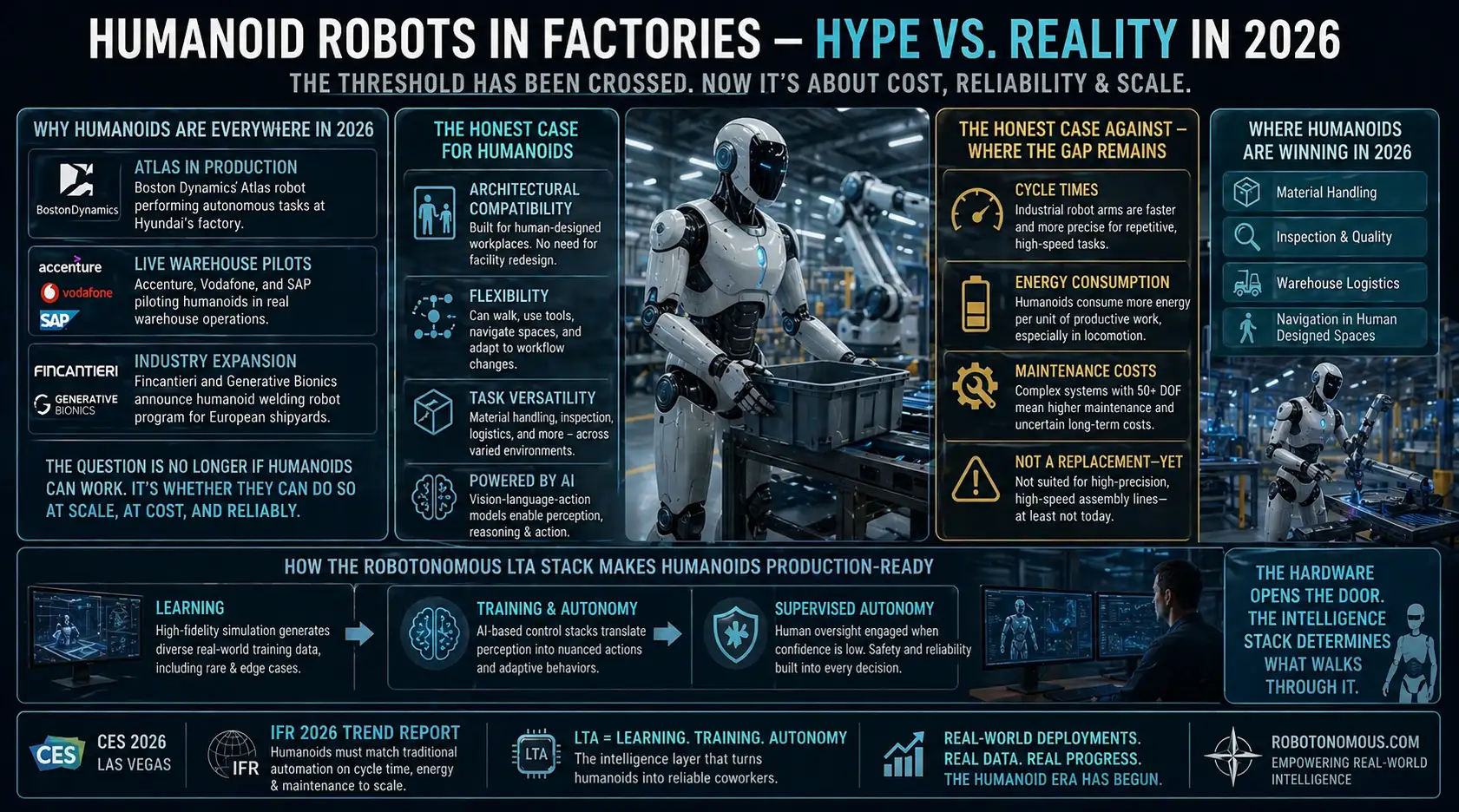
At CES 2026 in Las Vegas, something changed in how humanoid robots were presented. For years, the showcases felt conceptual — impressive demonstrations of balance and dexterity that left audiences wondering about real-world applications. This year, the systems on display were already in commercial use. Boston Dynamics’ Atlas robot was performing autonomous factory tasks at Hyundai’s production facility. Accenture, Vodafone, and SAP were piloting humanoids in live warehouse operations. In February, Fincantieri and Generative Bionics announced a humanoid welding robot programme for European shipyards.
The field has crossed a threshold. The question industry leaders are now asking is not whether humanoid robots can perform useful work — it is whether they can do so at a cost and reliability level that justifies deployment at scale alongside proven industrial automation.
The honest case for humanoids
The core argument for humanoid form factor is architectural compatibility. Human workplaces — factories, warehouses, logistics centres — were designed by humans, for humans. The tools, surfaces, access points, and workflows assume an operator with two arms, two legs, and the ability to navigate steps, narrow aisles, and equipment designed for hand operation. A humanoid robot inherits this compatibility. It can use existing infrastructure without requiring facility redesign, which dramatically reduces the capital cost of deployment in brownfield environments.
This flexibility is real and it matters. A traditional industrial robot arm requires a fixed installation point, a defined working envelope, and a controlled environment. It excels at high-volume, high-precision, repetitive tasks. But it cannot walk to a different workstation, pick up an unfamiliar tool, or respond to a workflow change without significant reprogramming. Humanoids, powered by physical AI and vision-language-action models, can do all of these things — in principle.
The honest case against — and where the gap still is
The IFR’s 2026 trends report is careful to note that for humanoids to achieve mass adoption, they must match traditional automation on cycle times, energy consumption, and maintenance costs. On all three dimensions, the gap remains significant. A purpose-built industrial robot arm performing a welding or assembly task operates with sub-millimetre repeatability at cycle times that current humanoids cannot match. Energy consumption per unit of productive work is higher for humanoids, partly due to the complexity of bipedal locomotion. And maintenance — the cost of keeping a system with 50-plus degrees of freedom operational in a production environment — remains an open question at scale.
The systems that are performing well in 2026 deployments are largely in roles that play to humanoid strengths: material handling, inspection, logistics, and tasks requiring navigation through human-designed spaces. They are not yet replacing high-speed, high-precision assembly lines — nor should they be expected to.
How the Robotonomous LTA stack supports humanoid deployment
The intelligence layer is what separates a capable humanoid demonstration from a reliable production deployment. Humanoid hardware — sensors, actuators, mechanical systems — is advancing rapidly. What determines whether a humanoid can actually perform in a factory is the quality of its perception, planning, and decision-making software. The Robotonomous LTA architecture provides exactly this layer: high-fidelity simulation for training on diverse real-world scenarios, AI-based control stacks that translate perception into nuanced physical action, and supervised autonomy frameworks that ensure human oversight is engaged precisely when the system’s confidence is insufficient for independent operation.
The humanoid era is not hype. But it is also not magic. The hardware opens the door. The intelligence stack determines whether anything useful walks through it.