
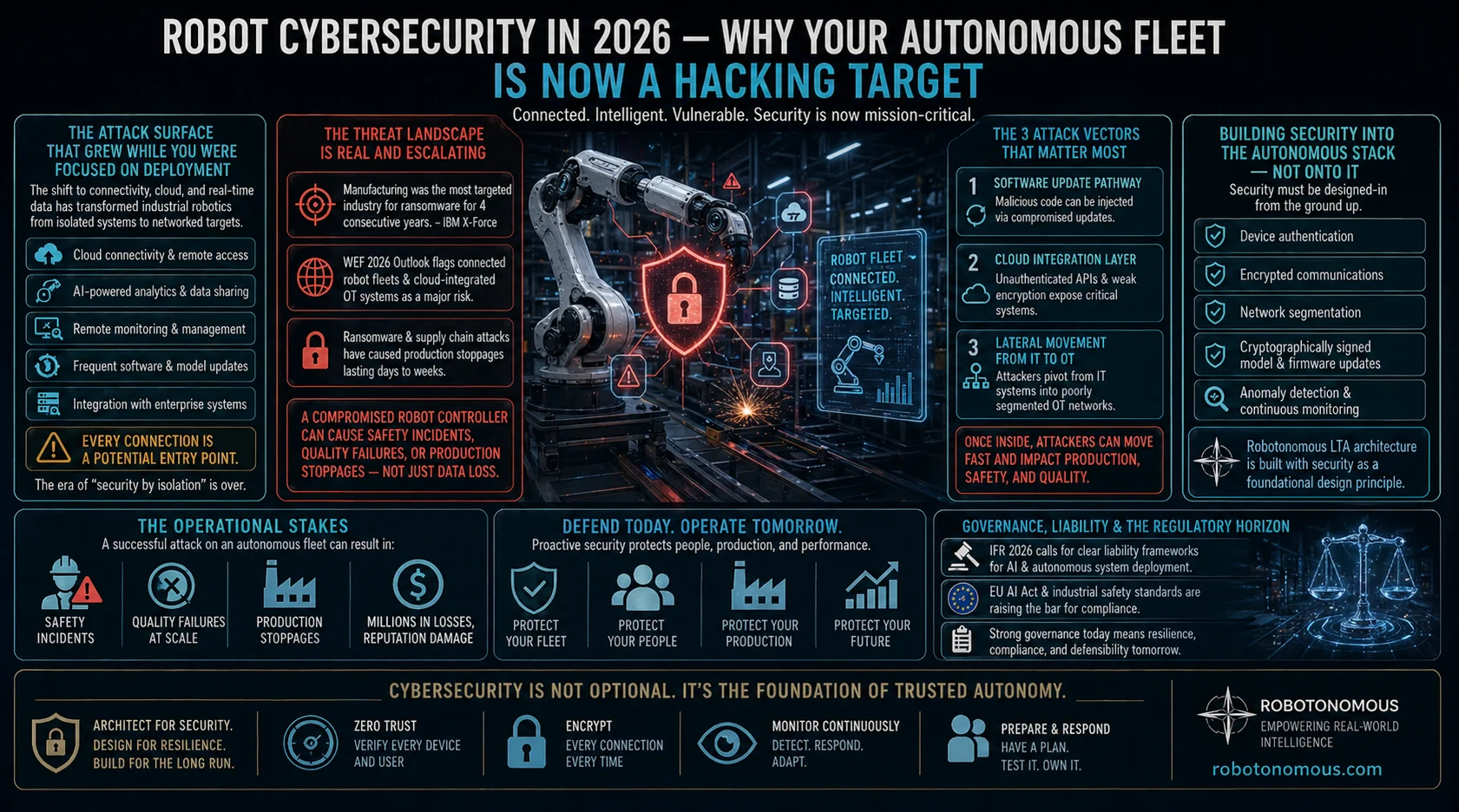
The attack surface that grew while you were focused on deployment
For most of the history of industrial robotics, cybersecurity was not a primary concern. Factory floor systems — PLCs, robot controllers, SCADA networks — were physically isolated from the internet. Their communication protocols were proprietary, their interfaces were arcane, and their attack surface was, in practice, limited to physical access. Security by obscurity was not elegant, but it largely worked.
That era is over. The same forces driving the value of autonomous robotics — cloud connectivity, AI-powered analytics, real-time data integration, remote monitoring and management — have fundamentally changed the attack surface of the industrial environment. Modern autonomous robot systems are networked devices. They communicate with cloud platforms. They receive software updates remotely. They share data with enterprise systems that are, by necessity, connected to the broader digital world. Every one of these connections is a potential entry point.
The threat landscape is real and escalating
IBM’s X-Force Threat Intelligence Index named manufacturing the most targeted industry for ransomware attacks for four consecutive years. The WEF’s 2026 Global Cybersecurity Outlook specifically flagged connected robot fleets and cloud-integrated OT systems as a growing attack surface that industrial organisations are underprepared to defend. The nature of the threat is not hypothetical. Ransomware attacks targeting industrial control systems have caused production stoppages lasting days to weeks at major manufacturers. Supply chain attacks — where a compromised software update is used to gain access to a target’s operational systems — have affected robotics software vendors and their downstream customers.
The consequences of a successful attack on an autonomous robot fleet are categorically different from those of a conventional IT breach. A compromised enterprise database is a data loss event. A compromised robot controller is a potential safety incident, a quality failure across thousands of units, or a production stoppage that cannot be resolved by restoring a backup. The operational stakes raise the priority of cybersecurity from an IT concern to a production continuity and safety concern.
The three attack vectors that matter most in autonomous robotics
Understanding where autonomous robotic systems are most vulnerable requires looking at the specific attack vectors that threat actors are exploiting. The first is the software update pathway. Autonomous robot systems receive frequent software updates — AI model updates, firmware patches, control stack revisions. Each update delivery mechanism is a potential vector for malicious code injection if not properly authenticated and integrity-checked. The second is the cloud integration layer. Data flowing between on-premise robot systems and cloud analytics platforms must be encrypted in transit and the endpoints must be authenticated — unauthenticated cloud APIs are consistently among the most exploited entry points in industrial environments. The third is lateral movement from IT to OT. Once an attacker gains access to enterprise IT systems through conventional phishing or credential theft, poorly segmented networks allow movement into OT systems that were never designed to resist internal network threats.
Building security into the autonomous stack — not onto it
The organisations that are managing robotic cybersecurity effectively in 2026 share one characteristic: they treat security as an architectural requirement, not a retrofit. Security that is bolted onto an existing system after deployment will always lag behind threats that were designed with that system’s specific vulnerabilities in mind. Security that is built into the system’s architecture — with device authentication, encrypted communications, network segmentation, and anomaly detection as first-class design elements — creates a defence that is proportionate to the threat.
The Robotonomous LTA architecture incorporates security considerations at the system design level. Communication between the autonomy stack components uses authenticated, encrypted channels. Model updates are cryptographically signed and integrity-verified before deployment. The autonomy layer’s network interfaces are designed for minimal exposure — the system communicates what it needs to communicate, through defined channels, to authenticated recipients. In a threat landscape where manufacturing is the primary target, this approach is not a differentiator — it is a baseline requirement.
Governance, liability, and the regulatory horizon
Beyond the technical dimension, robot cybersecurity in 2026 has a governance dimension that organisations are only beginning to address. The IFR’s 2026 trends report called for clear liability frameworks to govern AI deployment — recognising that when an autonomous system is compromised and causes harm, the existing legal frameworks for assigning responsibility are inadequate. The EU’s AI Act and evolving industrial safety standards are beginning to address this gap, but the regulatory landscape is still forming. Organisations that are investing in governance frameworks now — defining responsibility, establishing incident response procedures, and documenting security architectures — will be better positioned to meet compliance requirements as they crystallise and to demonstrate due diligence if an incident occurs.